PersonaTree — Structured Lifecycle Memory for Person Understanding
An agent memory framework that organizes long-term interaction into a three-level tree — evidence leaves, behavioral-pattern mids, durable persona-claim roots — with typed support edges, so abstract judgments about a user stay traceable to the observations that justify them.
Background
LLM agents are increasingly expected to interact with the same user over months. In that setting memory needs to do more than recall isolated facts; it needs to track recurring preferences and states and form durable judgments about the person. Recent benchmarks for lifelong companions have shifted exactly this way — from factual recall toward person understanding.
The difficulty is that abstract judgments about a user must be grounded in scattered, situated observations. The paper frames this through schema theory from cognitive psychology (Bartlett 1932; Rumelhart 1980): schemata organize prior knowledge and guide how new observations are interpreted. A few hiking queries are partial evidence; repeated observations gradually support a more general expectation. Without that grounding, an answer model can retrieve plausible user information but has little basis for explaining why an abstract interpretation follows from the history.
Existing systems — MemGPT (OS-style context management), Mem0 and A-MEM (scalable persistent stores), Zep/Graphiti (temporal knowledge graphs), LightMem — are strong operational baselines, but their interfaces center on records, notes, summaries, graphs, or retrieved snippets. Structured-memory methods (RAPTOR, MemTree, TiMem) add hierarchy for entity, temporal, or topical organization. PersonaTree’s distinctive use of hierarchy is evidential abstraction for person understanding: linking events, patterns, and persona claims so the abstract interpretation stays grounded.
Core Idea
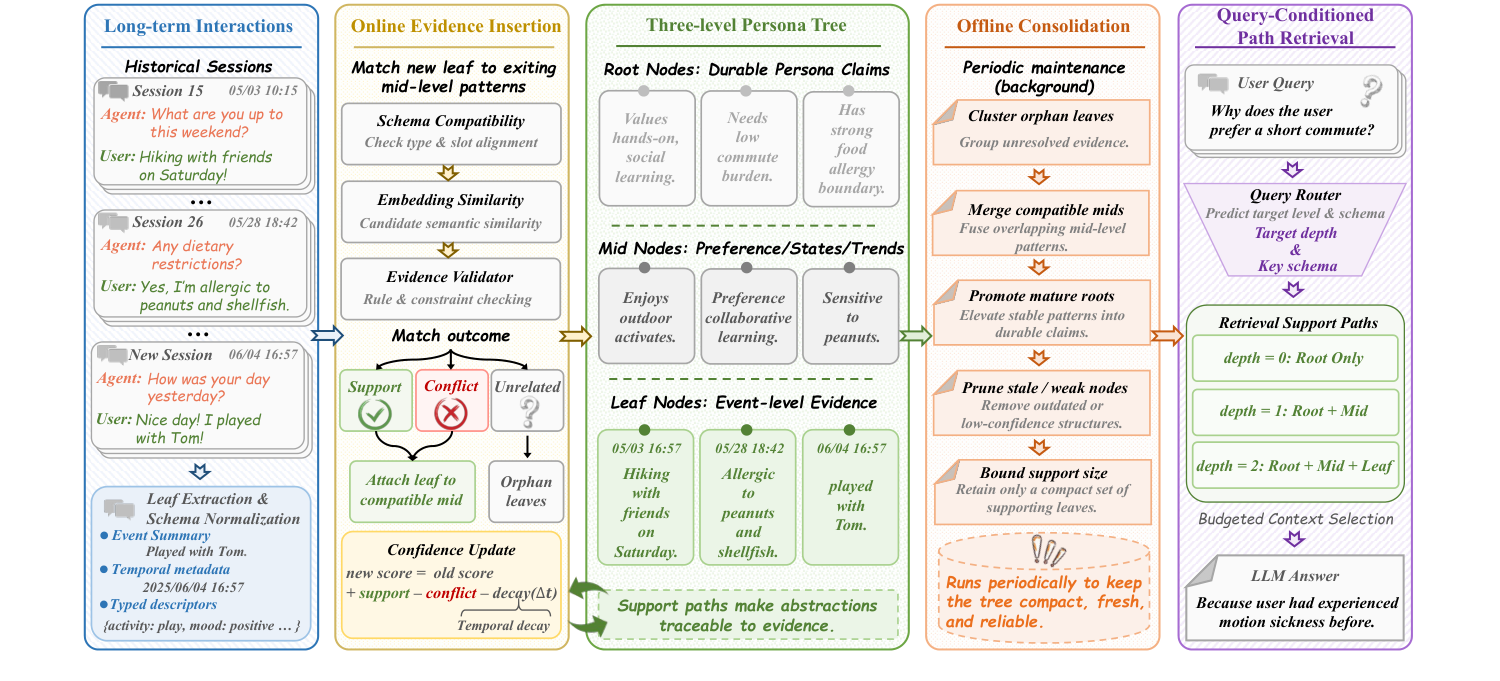
The memory is a typed graph whose support edges form a three-level tree. Leaf nodes record event-level evidence from one interaction. Mid nodes capture reusable behavior or state abstractions — preferences, ongoing states, recurring triggers, temporal trends. Root nodes hold durable user claims about identity, personality, values, principles, and safety-relevant boundaries. Each node carries content, temporal metadata, schema attributes, an embedding, a confidence, and its abstraction level. The support edges are the point: every abstract claim remains traceable to the observations that justify it.
Method
Conservative writing: insertion with an evidence validator
A new interaction becomes a typed leaf, then is matched against existing mids. Crucially, semantic similarity alone does not decide attachment. A candidate mid must first be schema-compatible with the leaf; among compatible candidates, an evidence validator labels the relation as support, conflict, or unrelated, mapped to positive, negative, or near-zero evidence weight. The match score combines a schema-compatibility predicate with the validator judgment and the embedding similarity. The leaf attaches only if the best match clears a threshold; a detected conflict keeps the leaf separate and passes negative weight to the confidence update; an unmatched leaf stays orphaned until consolidation has enough context for a safe abstraction. The design refuses to abstract on thin evidence.
Confidence in log-odds, with decay
Confidence is updated in log-odds space with temporal decay and validator-derived weights — support and conflict act as positive and negative evidence, a sigmoid keeps the value bounded, and the decay term pulls confidence back toward a baseline prior when no new evidence arrives. Schema types whose content should persist (stable facts) use reduced or zero decay; transient behavioral patterns fade without reinforcement. This is what lets the tree forget gracefully rather than accrete forever.
Offline consolidation and root promotion
A periodic pass revisits orphan leaves and low-confidence nodes. It clusters orphans by schema attributes, temporal proximity, and semantic similarity; a cluster becomes a mid only when it holds enough evidence to support a consistent pattern. Root promotion is stricter than mid consolidation — a mid must pass thresholds on confidence, support size, and temporal coverage before compatible mids are grouped and summarized into a durable claim. The same pass bounds growth: stale nodes decay, old orphans are removed, mids keep only a bounded set of supporting leaves, and weak roots are pruned (detaching their mids, which survive as local patterns).
Query-conditioned path retrieval
Retrieval is conditioned on the granularity of the query. A router predicts the needed abstraction level and schema-attribute constraints, then renders the shallowest useful view and expands along the support path only when the answer needs more: a root alone (), a root with its supporting mid (), or the full root–mid–leaf chain (). A token-budgeted selection favors renderings aligned with the query and backed by reliable nodes while penalizing token cost — so a factual question is answered from compact event memories, and an abstract one gets the claim plus the evidence trail behind it.
Experiments
The suite spans person-understanding/preference benchmarks (KnowMe, RealPref, CUPID) and long-term memory benchmarks (LongMemEval, RealMem, LoCoMo-Plus), each answered by Qwen3-32B, Gemini 3 Flash, and GPT-5.4 Mini. Against full-history prompting, flat retrieval, and persistent-memory baselines (Mem0, A-MEM, TiMem), PersonaTree ranks first in 12 of 18 compact scores and top-two in 16. The Qwen3-32B slice:
| Benchmark | Full history | Flat retrieval | TiMem | PersonaTree |
|---|---|---|---|---|
| KnowMe | 39.9 | 43.3 | 46.1 | 47.6 |
| RealPref | 60.1 | 73.5 | 76.9 | 78.1 |
| RealMem | 39.1 | 40.3 | 44.3 | 47.8 |
| CUPID | 48.8 | 50.1 | 53.1 | 55.8 |
| LoCoMo-Plus | 20.1 | 20.4 | 20.9 | 22.3 |
| LongMemEval | – | 68.1 | 72.7 | 72.3 |
The advantage is most consistent where stable user modeling and preference use matter (CUPID best under all three backbones); on the pure long-term-recall benchmark LongMemEval, the temporally-organized TiMem edges it out — a reminder that the hierarchy is tuned for understanding, with raw recall a secondary target.
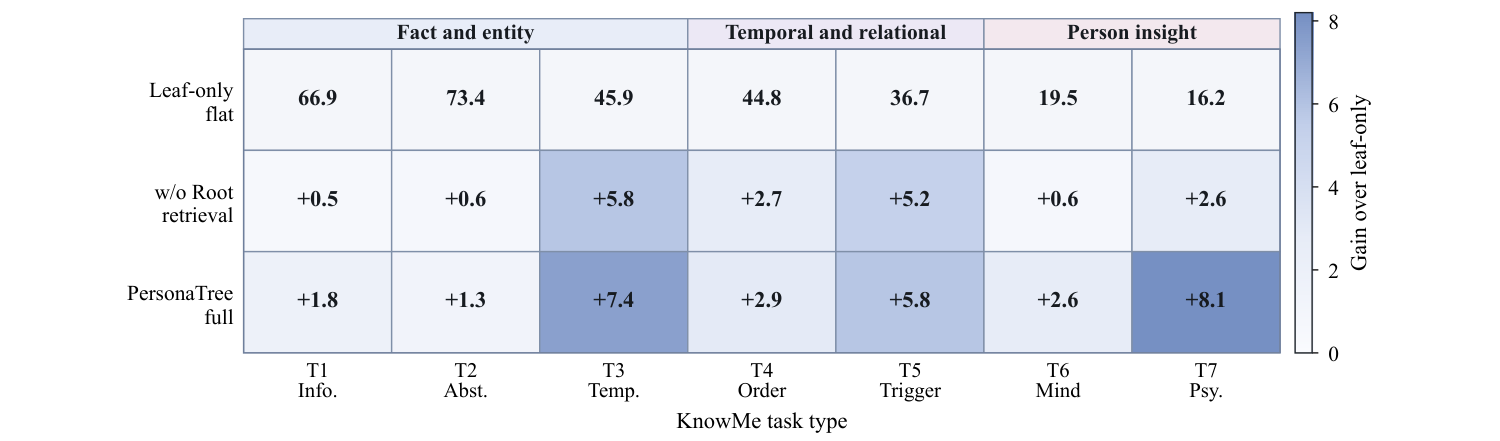
Two ablations isolate why. Hierarchy (Fig. 2): retrieving over the full Leaf→Mid→Root structure lifts the KnowMe macro average from 43.3 (leaf-only) to 47.6, with the largest gain on T7 — expert-written questions about motivation and identity — rising 16.2 → 24.3. Path retrieval: holding the same node inventory fixed and changing only how it is returned, support-path rendering beats ranking all nodes as a flat pool, 75.7 → 78.1 on RealPref, under a smaller context (2.99k vs 3.18k tokens). Most of that gain is in generation quality (preference alignment 3.61 → 3.91), which is the signature of grounding: the answer model does better when the claim arrives with its evidence attached. An activation trace confirms the design works as intended — factual questions (T1/T2) mostly activate leaves, temporal questions (T4/T5) shift to mids, and insight questions (T6/T7) reach for roots.
Efficiency. Against full-history prompting on RealPref, PersonaTree improves the score 60.1 → 78.1 while cutting the P95 answer input from 30.23k to 2.99k tokens and input growth from 24.46k to 0.27k tokens per 100 turns — the context stays roughly flat as the history grows.
Limitations
The work is text-only and evaluated on English benchmarks; whether the same lifecycle schema holds when user evidence arrives through speech or multiple modalities, or in other languages, is untested and named as future work. The method also introduces two LLM-judgment dependencies of its own: the evidence validator that gates insertion, and the router that picks the retrieval level. Their consistency bounds the system’s reliability, much as the LLM judge does in other persona work. And as with any persistent user-profiling system, the ethics statement flags that deployment needs real data-governance: transparency about what is stored, user control, and safeguards for personal data.
References
- Original paper: PersonaTree: Structured Lifecycle Memory for Person Understanding in LLM Agents
- MemPalace (verbatim episodic memory): github.com/MemPalace/mempalace — covered earlier in this series
- Hierarchical Multi-Persona Induction (intent-compressed user profiling): Choi et al. (2026), arXiv:2604.26120 — covered earlier in this series
- Mem0: Chhikara et al. (2025), arXiv:2504.19413; A-MEM: Xu et al. (2026)
- TiMem (temporal-hierarchical memory): Li et al. (2026), arXiv:2601.02845; MemTree: Rezazadeh et al. (2025)
- LongMemEval: Wu et al. (2024), arXiv:2410.10813; KnowMe: Wu et al. (2026), arXiv:2601.04745
- Schema theory: Bartlett (1932); Rumelhart (1980)