Should LLM Agents Decide in Social Simulations? — Finite-State vs. LLM Policies
A controlled test of whether an LLM, asked to pick an agent's next action in a social-network simulation, preserves the explicit finite-state policy a researcher intended — measured by Jensen–Shannon divergence across three open models and three prompting strategies.
Background
Agent-based simulation earns its keep by being inspectable: explicit rules, finite-state machines, and Markov transition policies are reproducible, cheap, and their assumptions are written down. In online-social-network (OSN) studies — especially adversarial ones about misinformation reach or campaign amplification — this matters, because small changes in how agents choose actions move the measured outcomes a lot.
LLM-based agents trade that inspectability for flexibility. They interpret context, carry memory, and generate language, and several recent simulators (OASIS, covered earlier in this series; Y Social; MOSAIC) let the LLM also decide what the agent does next. The moment action selection is delegated to a prompt, the behavioral policy becomes a function of the model, the prompt, and the context — none of which is guaranteed to match the researcher’s intent. A growing body of evidence (Chirper.ai analyses, persona-conditioned survey studies) already shows LLM outputs diverging from intended behavior. This paper isolates the question to one variable: holding the agents, network, action space, and context fixed, does an LLM selector reproduce an explicit reference policy, and how does that depend on model and prompt?
Core Idea
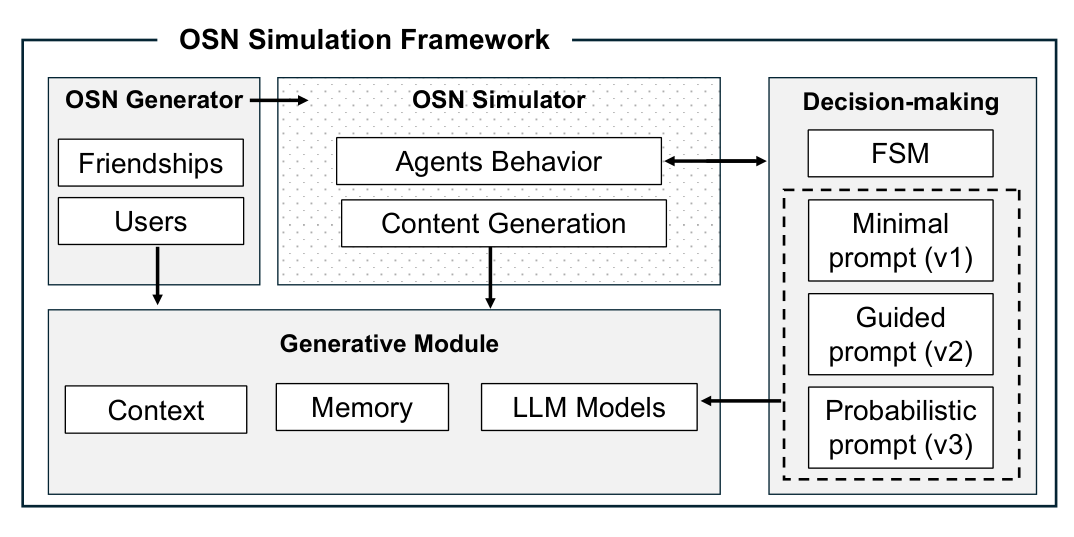
The simulation is a microblogging platform with synthetic profiles, a homophily-generated directed follower graph, and a fixed action space:
Agents are activated sequentially; at each step the activated agent picks exactly one valid action. The only thing that changes between conditions is the selector. The reference is a finite-state machine, a first-order Markov model whose transition probabilities depend on the agent’s user type. The four conditions are that FSM plus three LLM prompting strategies. Each receives the identical agent profile, current state, valid-action mask, and local context.
The population is deliberately skewed like a real platform: 547 Passive users (54.7%), 221 Socializers (22.1%), 135 Debaters (13.5%), and 97 Advanced users (9.7%). Under the FSM, read dominates every user type — the consumption-heavy shape real OSN traces show.
Method
The three prompts: minimal, guided, probabilistic
The prompts form a ladder of how much of the reference policy is handed to the model:
- Base / minimal (v1) — agent metadata, recent state, the valid actions, and short definitions, with just enough framing to avoid two artifacts: framing selection as an optimization problem, and artificially balancing actions. This exposes the model’s default action preferences.
- Guided (v2) — adds five behavioral rules distilled from empirical OSN research. Users consume feed content before reacting. Content creation is unequally distributed. Actions differ in effort, from a cheap
liketo an effortfulpost. User roles shape engagement. Andfollow/unfolloware ordinary actions. Calibration rules follow, discouraging the model from over-picking linguistically easy actions likepostorreply. - Probabilistic (v3) — hands the model the FSM’s actual numbers: the fixed action order, the current state, the user-type transition probabilities, the contextual mask, and the final normalized probabilities, instructed to use them as strong priors without always taking the argmax.
Measuring drift
Alignment is the Jensen–Shannon divergence between the LLM’s action distribution and the FSM reference, with Laplace smoothing () and base-2 logs so values land in ; lower is closer. Execution time over the 10,000 decisions is reported alongside. Three open-weight models — Llama-3.1-8B, gpt-oss-20b, Mistral-Small-3.2-24B — are served under one local vLLM setup (temperature 0.7, top-p 0.9, top-k 40), so prompt effects can be compared across model families rather than attributed to one implementation.
Experiments
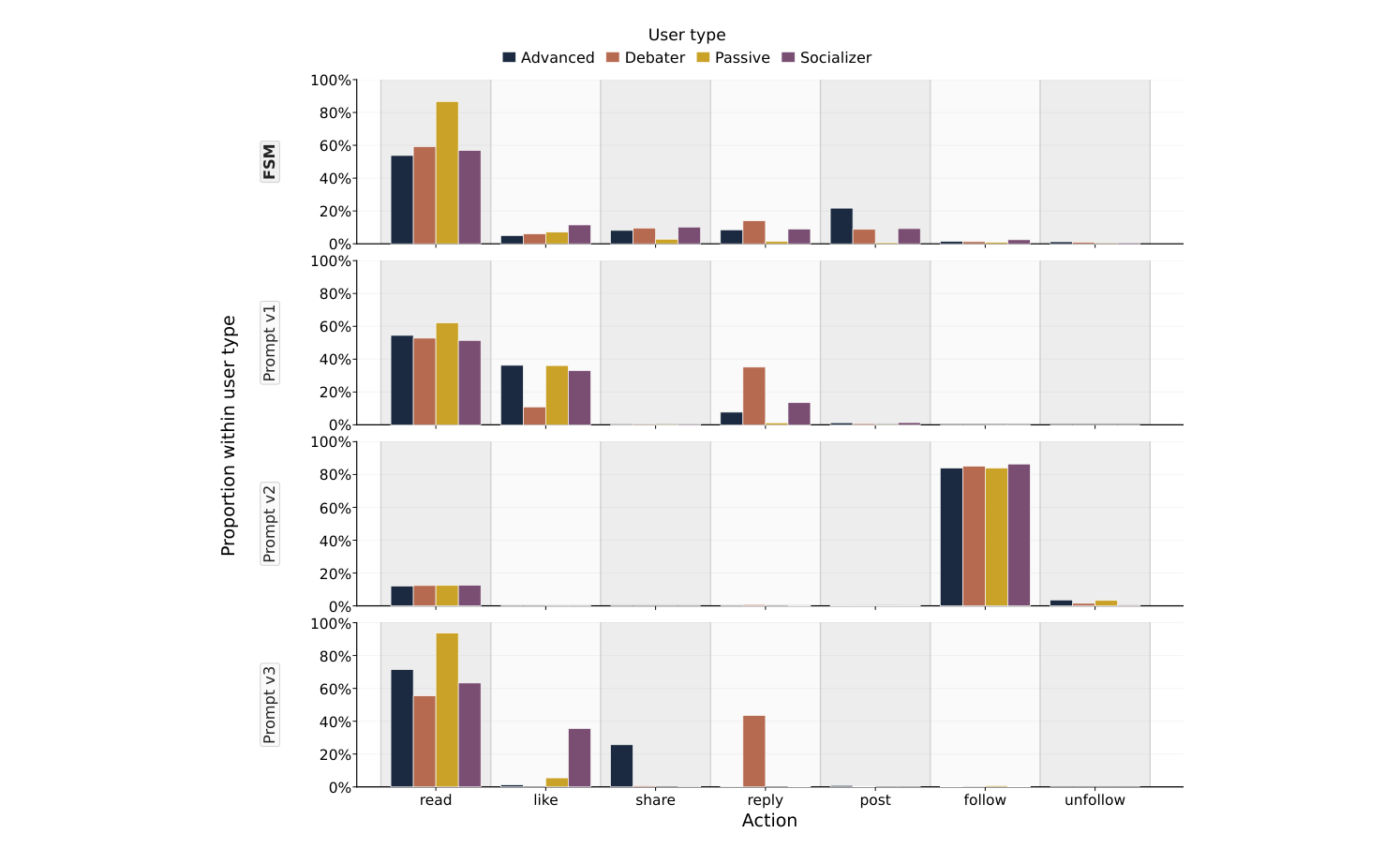
The central table is alignment per model × prompt (lower JSD = closer to the intended policy):
| Model | Base (v1) | Guided (v2) | Probabilistic (v3) | Model mean |
|---|---|---|---|---|
| LLaMA-3.1-8B | 0.359 | 0.223 | 0.278 | 0.287 |
| GPT-OSS-20B | 0.113 | 0.672 | 0.035 | 0.273 |
| Mistral-24B | 0.045 | 0.055 | 0.132 | 0.077 |
| Best prompt | Mistral | LLaMA | GPT-OSS | — |
Three readings. First, no prompting strategy wins across models: the guided prompt is best for LLaMA, the probabilistic prompt is best (and excellent, 0.035) for GPT-OSS, and the minimal prompt is best for Mistral. Whatever closes the gap for one model can open it for another. Second, more guidance is not more fidelity — GPT-OSS’s guided-prompt collapse to follow (0.672, Fig. 2) is the clearest evidence that injected behavioral rules can induce a systematic bias the researcher never intended. Third, Mistral-24B is the most faithful overall (mean 0.077), but it is also the most expensive to run — fidelity and efficiency point at different configurations.
That cost gap is the unambiguous result:
| Decision policy | JSD | Time (10k actions) | Slowdown vs FSM |
|---|---|---|---|
| FSM (Markov sampling) | 0.000 | 7 s | 1× |
| Fastest LLM config (LLaMA v1) | 0.359 | 946 s | 135× |
| Best-aligned config (GPT-OSS v3) | 0.035 | 2,990 s | 427× |
| Slowest config (Mistral v2) | 0.055 | 9,360 s | 1,337× |
Across all nine LLM configurations, action selection averaged 563× slower than the FSM, and even the fastest was 135× slower — all to reproduce a distribution the Markov chain produces exactly, by definition, for free.
Limitations
The study is scoped to the decision distribution in isolation. It establishes that LLM selectors diverge from an explicit policy and quantifies by how much. What it does not yet do is connect a given JSD gap to the simulation-level quantities researchers care about: diffusion depth, engagement, network evolution, narrative amplification. The authors name that as the next step. The reference policy is itself a simplification (a first-order, user-type-conditioned Markov model), so “fidelity” here means fidelity to that abstraction and says nothing about how closely either policy tracks real people. And the findings are specific to three open-weight models under one decoding configuration; larger or proprietary models, or different temperatures, could shift the rankings (the strong prompt-sensitivity of GPT-OSS is a warning that they might).
References
- Original paper: Should LLM Agents Decide in Social Simulations? Comparing Finite-State and LLM-Based Decision Policies
- OASIS (LLM-driven OSN simulation at scale): Yang et al. (2024), arXiv:2411.11581 — covered earlier in this series
- Underlying OSN simulation framework: Buitrago López et al. (2025), arXiv:2512.22082
- Synthetic OSN via homophily: Buitrago López et al. (2026), IEEE TCSS
- Y Social (LLM social-media digital twin): Rossetti et al. (2024), arXiv:2408.00818
- MOSAIC (content dissemination simulation): Liu et al. (2025), EMNLP 2025
- Generative Agents (origin of LLM social simulacra): Park et al. (2023)