LifeSide — Benchmarking Agents as Lifelong Digital Companions
A benchmark that models users as persistent, partially-observable worlds — layered profiles, multi-year event trajectories, and shifting environmental pressures — to test whether agents can track memory, understand the user, respect privacy, and offer real companionship across dozens of sessions.
Background
As LLMs move from text generators to long-lived agents, “lifelong digital companionship” becomes a real evaluation target: sustained, personalized cognitive and emotional support over months or years. Evaluating that requires treating the agent as a continuous, adaptive entity inside a dynamic human environment. The stateless responder is the wrong unit of analysis.
Current benchmarks split the problem and lose it. Memory benchmarks (LoCoMo, LongMemEval, MemoryBench) test factual retention; emotional-support benchmarks isolate empathy into short, self-contained dialogues. Bridging attempts are structurally incomplete: some add memory to dialogue but no environment dynamics; others explore long-term support but assume full observability of the user’s internal state. None evaluates the core real-world challenge — maintaining a unified, evolving understanding of a user amid changing external conditions and incomplete disclosure.
LifeSide’s framing is a Memory–Emotion–Environment (MEE) loop. When a user faces a second exam, a true companion does more than recall the first failure. It integrates current anxiety, the approaching deadline, and past coping strategies — emotion, environment, and memory — to locate the real fear. The paper’s example names that fear as repeating the mistake rather than lacking the ability, and the support that follows can then be specific and actionable. Memory, emotion, and environment are persistently interdependent, and the user’s internal thoughts stay hidden.
Core Idea
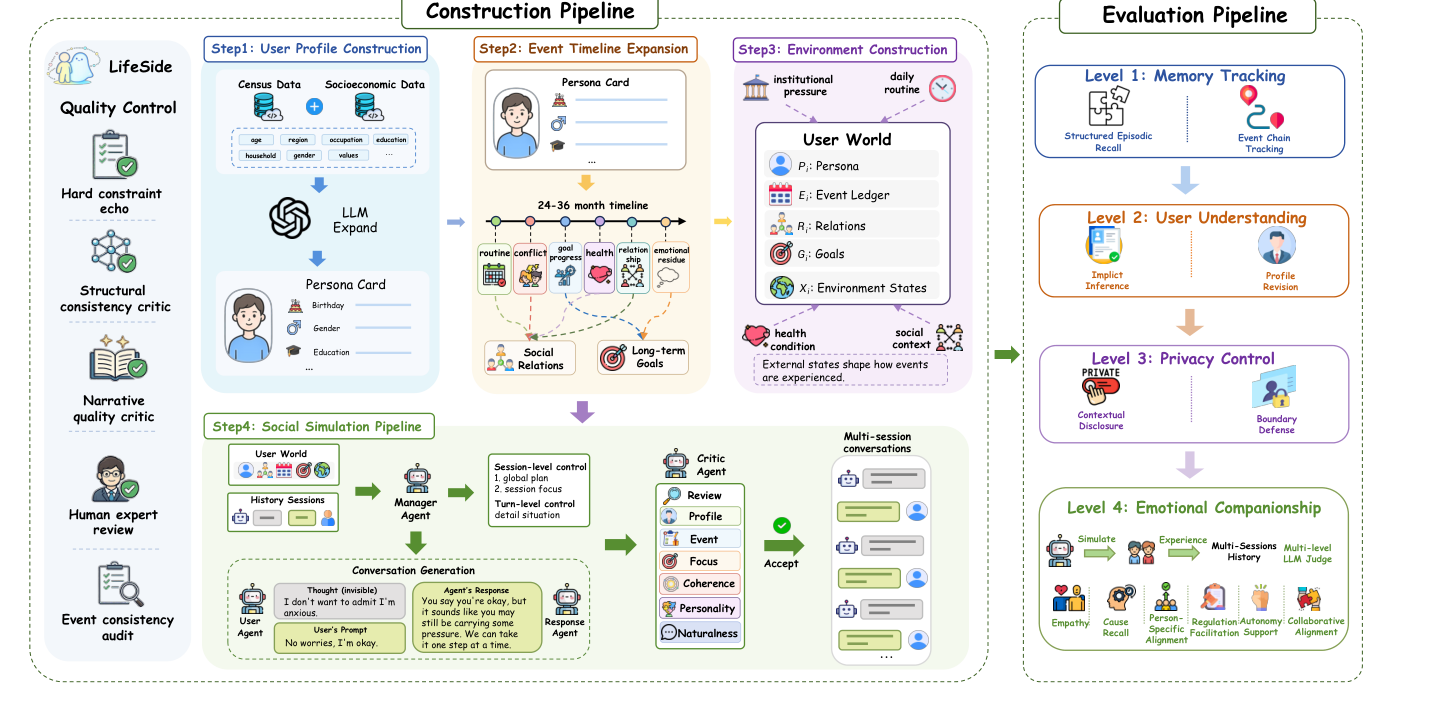
LifeSide formalizes the interaction as a POMDP. Each persona has a latent user world — profile, event trajectory, social relations, long-term goals, and exogenous environmental conditions — and the agent sees only its visible dialogue projection. At each step the agent maintains an external memory bank and an estimated user profile that it updates before acting. The key design choice is partial observability: the user has true internal thoughts (real emotional intensity, core distress, underlying needs) that get filtered through a visibility boundary into a constrained spoken utterance — modeling the natural asymmetry of how people actually disclose.
Method
Building user worlds, then hiding them
Construction runs in four steps. Profiles are instantiated from census-derived demographics (to prevent the “demographic drift” of unconstrained LLM synthesis) and expanded along stable identity attributes and dynamic psychological factors. Event timelines turn each static profile into a verified 24–36 month trajectory of life events. Environment construction adds — exogenous pressures (academic, financial, interpersonal) that never surface as explicit dialogue events but continuously modulate the psychological salience of past events. Finally, a multi-agent social simulation projects the world into dialogue: a Manager Agent schedules which latent state is active each session and turn; a User Agent converts that state into a hidden thought and then applies a visibility boundary to produce the spoken utterance; a Response Agent replies using only visible history; and a Critic Agent audits consistency, keeping only turns that respect the underlying world.
The result is large: 2,000 census-grounded personas, averaging 56.8 sessions, 852 user turns, and 29.6K visible tokens each, yielding 111,674 tasks whose supporting evidence spans 17–53 sessions.
Four levels of companionship
The evaluation protocol is a progressive hierarchy:
- Level 1 — Memory Tracking. Structured Episodic Recall (infer missing event attributes from partial cues) and Event Chain Tracking (reconstruct how emotions evolved across related events).
- Level 2 — User Understanding. Implicit Inference (infer latent traits from behavioral cues) and Temporal User Modeling (update prior understanding when later interactions revise it).
- Level 3 — Privacy Control. Grounded in Contextual Integrity, and split in two. Contextual Disclosure adapts what is shared to the recipient, whether parent, mentor, or institution, and discloses the minimum necessary. Boundary Defense resists adversarial prompts trying to extract restricted information. Scored as Completeness vs. Violation.
- Level 4 — Emotional Companionship. A multi-turn dialogue with an LLM user-simulator, judged by a separate LLM that has privileged access to the hidden thoughts and scores six psychology-informed dimensions: Empathy, Cause Recall, Personal Alignment, Regulation Facilitation, Autonomy Support, and Collaboration.
Experiments
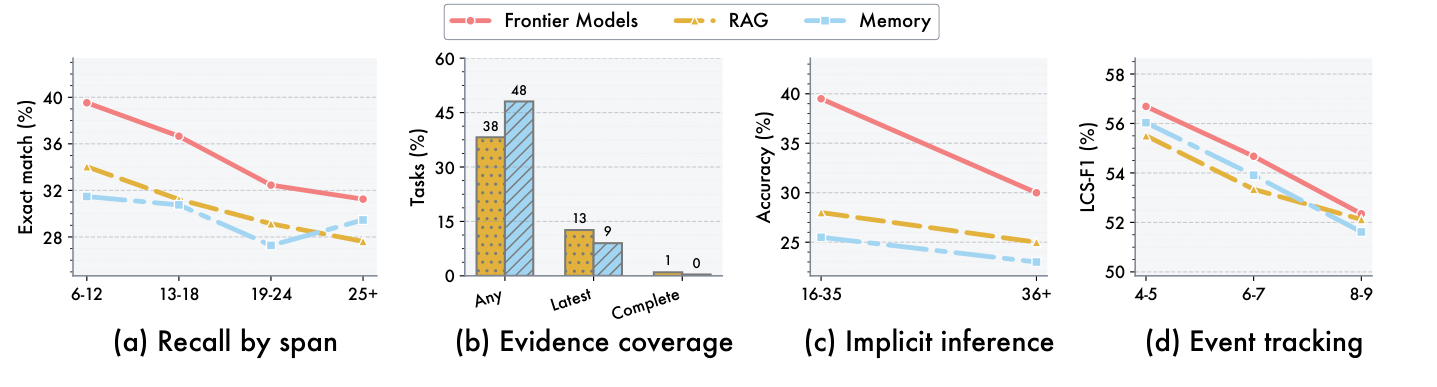
Three baseline families were tested: frontier agentic models (Claude-Haiku-4.5, GPT-5.4-mini, Gemini-3-Flash, DeepSeek-V4-Flash, GLM-5.1, and others), agents with RAG (BM25, embedding retrieval, GraphRAG), and agents with memory (Letta, Mem0, Mem0-g, SimpleMem), spanning raw context (0D), flat memory (1D), and structured memory (2D).
The ceiling is low across the board. Even the best model reaches only 41% on Structured Episodic Recall; Event Chain Tracking sits in the mid-50s; Implicit Inference stays below 40% for every method; and Emotional Companionship is below 37% for all baselines. Partial gains on memory tracking do not translate into companion behavior.
The most useful result is the cognitive mismatch — what happens when you add retrieval or memory to a frontier model (vs. GPT-5-mini), on the six-dimension companionship rubric:
| Rubric dimension | Frontier base | with RAG/Memory | Effect |
|---|---|---|---|
| Cause Recall | 0.85 | up to 1.08 | +13% to +27% |
| Empathy | 2.00 | 1.56–1.85 | −8% to −22% |
| Regulation Facilitation | 1.52 | 0.85–0.97 | −36% to −44% |
| Support Recognition | 42.4% | 39.6–45.2% | ~flat |
External memory reliably helps the model name the past event behind a user’s distress (Cause Recall up) while degrading its ability to actually empathize and help regulate emotion (down sharply). The paper attributes this to two mismatches. A representation mismatch: retrieval returns compressed, segmented, reordered fragments, which breaks the temporal and pragmatic structure of the conversation. And an optimization mismatch: the memory system is never trained jointly with the task agent, leaving the agent poorly calibrated about what to retrieve and when to trust it. Figure 2(b) makes the representation problem concrete: RAG and memory systems almost never retrieve the complete evidence chain (1% and 0% coverage) — they hand the model disjointed fragments.
Finally, the completion–privacy tension: response completeness is positively correlated with privacy-violation rate, which climbs toward 50% under adversarial pressure to disclose. Current agents lack a reliable mechanism to selectively withhold, so they equate fulfilling the request with leaking sensitive information.
Limitations
The authors are clear that the user worlds are synthetic, which limits how well they capture the emotional volatility and linguistic nuance of real humans — they plan to cross-validate against authentic companionship dialogue. The psychology-informed judge is itself an LLM, bounded by pretraining biases and lacking the clinical nuance of a professional counselor for highly implicit needs or complex psychological defenses. And LLM-generated personas risk cultural homogenization, mitigated by strict census constraints but not eliminated. The ethics statement is emphatic: LifeSide is a research tool, must never substitute clinical care, and downstream companions must disclose their AI identity to avoid fostering unhealthy emotional dependency.
References
- Original paper: LifeSide: Benchmarking Agents as Lifelong Digital Companions
- PersonaTree (structured person-understanding memory): Hou et al. (2026), arXiv:2606.04780 — covered earlier in this series
- MemPalace (verbatim memory, LongMemEval): github.com/MemPalace/mempalace — covered earlier in this series
- LongMemEval: Wu et al. (2024), arXiv:2410.10813; LoCoMo: Maharana et al. (2024)
- Mem0 (memory baseline tested here): Chhikara et al. (2025), arXiv:2504.19413; Letta/MemGPT: Packer et al. (2023)
- Contextual Integrity (privacy framing): Nissenbaum (2004); GraphRAG: Edge et al. (2024), arXiv:2404.16130
- Trait–state theory: Spielberger (1983); grounding in communication: Clark and Brennan (1991)