ARCANE — Do Role-Playing Agents Stay in Character at the Right Time?
A benchmark that asks whether a role-playing agent's behavior shifts with the character's psychological arc, over and above reproducing a fixed persona — posing the same scenario at different narrative phases, including scenarios the source text never explores.
Background
Role-playing language agents (RPLAs) are among the most popular uses of conversational AI, and user expectations have moved from fluency to authentic portrayal. But authenticity over a long narrative means change: a character’s values and behavioral patterns shift as events accumulate. Most evaluation has not kept up. Benchmarks measure a character’s trait inventory, surface style, or — in the temporal case, like TimeCHARA — whether the character commits factual hallucinations by knowing something they shouldn’t yet. Suppressing spoilers is necessary but not sufficient: beyond what a character knows, how they would behave also evolves.
ARCANE borrows a distinction from personality psychology (McAdams): Layer 1 is the stable set of dispositions a character carries throughout the story; Layer 2 is whether those dispositions are expressed at the right moment. Prior RPLA benchmarks treat the character as a static target to be reproduced. ARCANE asks the Layer-2 question, and chooses novels as its testbed precisely because character evolution unfolds vividly across many chapters, with rich internal description and explicit temporal structure.
Core Idea
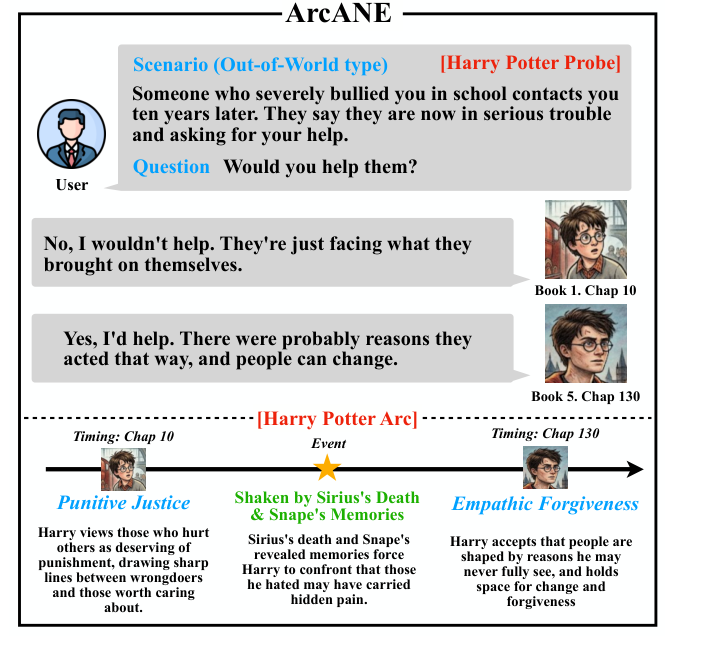
Two constructs make this measurable. A Character Arc aligns a character’s key events with their evolving psychological states, organizing both into a phase-segmented trajectory along a single axis — a psychological dimension defined by two pole descriptions (Harry’s moral axis runs Punitive Justice → Empathic Forgiveness). Each phase has a chapter range, a state description, and the key moments that anchor it. A probe is a (scenario, question) pair with one reference response per phase. Because the same scenario is asked at every phase, success requires more than knowing the character’s overall personality — the model must identify which phase the character is in and respond from there.
Probes come in three categories that form a difficulty gradient by distance from the source: In-Scenario lifts a verbatim passage; In-World invents an unwritten situation inside the source’s setting; Out-of-World transposes the scenario to a non-source era. In-Scenario can be answered from the passage; Out-of-World can be answered only from the arc.
Method
Constructing arcs and probes
Arc construction runs two independent chapter-level streams — an event stream (psychologically impactful events) and a state stream (cross-sectional psychological profiles) — so that event omission stays separable from state misreading. Each induces candidate axes (intrapersonal: beliefs, motives, coping; relational: trust, esteem, antagonism), an analyst LLM reconciles them, and a three-critic LLM ensemble validates literary grounding; for the evaluation split, three human annotators independently re-assess and only 2-of-3-validated axes are kept.
Probe generation drafts, for each (target phase, category), one probe whose target-phase response reflects actual behavior and whose other responses are counterfactual — each remaining phase’s behavior projected onto the same scenario. Validation is strict: Q-Voice checks in-character voice and knowledge cutoff, Q-PhaseFit asks a blind judge which phase a response best fits, and Q-World/Q-Anchor check setting rules. The dataset spans 17 novels, 80 characters, 544 arcs, and 4,601 probes, split into training (10 novels), a human-validated evaluation slice (5 novels, 1,754 probes), and a low-popularity slice (2 novels) held out as a memorization control.
Training arc-aware agents
Because each probe is answered across phases, the data naturally yields contrastive pairs. ARCANE-8B/32B (from Qwen3-8B/32B) are trained in two stages: SFT learns the response format, then DPO learns to distinguish ground-truth phase behavior from plausible but temporally displaced alternatives — speech that fits the character but belongs to a different narrative phase. This is the “right character, wrong phase” failure made into a training signal.
Metrics
An LLM judge scores responses against the phase reference at two granularities. Three scores work per phase. APF, Action Phase-Fidelity, compares the overt action against the reference on strategy, valence, and target. RPF, Reasoning Phase-Fidelity, parses the reasoning into trigger, appraisal, goal, and strategy slots. RAE, Reasoning–Action Entailment, asks whether the reference reasoning would actually license the action taken. One trajectory score: PTF (Phase Trajectory Fidelity), which sees all phase-keyed (reference, response) pairs at once and grades alignment, direction, and shape — catching a model that scores well per-phase but collapses adjacent phases or moves along the axis backwards.
Experiments
Across six models and six context modes (Vanilla, Summary, RAG, LifeChoice, TimeCHARA, and Arc), Arc-grounded context gives the best Overall score on every model, and is the top mode on 29 of 30 (model, novel) cells:
| Model | Best non-Arc Overall | Arc Overall | Gap |
|---|---|---|---|
| DeepSeek-V4-Pro | 57.7 (LifeChoice) | 62.4 | +4.7 |
| DeepSeek-V4-Flash | 56.1 (LifeChoice) | 59.7 | +3.6 |
| Qwen3-32B | 47.4 (LifeChoice) | 50.1 | +2.7 |
| Qwen3-8B | 40.9 (RAG) | 43.1 | +2.2 |
| ARCANE-32B | 52.0 (RAG) | 60.4 | +8.4 |
| ARCANE-8B | 48.5 (RAG) | 56.9 | +8.4 |
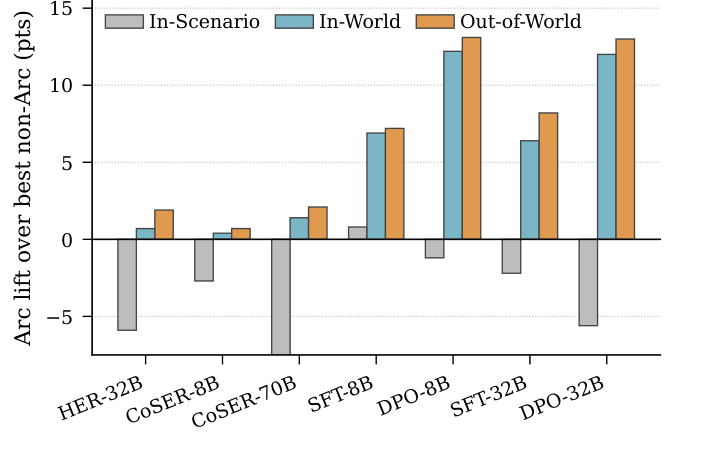
The lift is not uniform across categories, and the structure explains why. For DeepSeek-V4-Pro the Arc-vs-best-non-Arc Overall gap is +0.5 on In-Scenario, +5.2 on In-World, +7.7 on Out-of-World. An In-Scenario probe lifts its scene from a verbatim passage, so source-text retrieval already returns the relevant scene and the arc adds little; In-World and Out-of-World probes have no such passage, and only the arc supplies the phase of the query chapter. The same ordering shows up on the trajectory metric: the PTF gap reaches +1.1 / +7.0 / +8.2 across the three categories — Arc is the only mode that supplies the per-chapter trajectory PTF grades against.
Three robustness checks make the result hard to explain away. MIXEDARC swaps in another character’s arc from the same novel, and fails to clear even the Vanilla baseline. On the trained model it scores below Vanilla. The gain therefore traces to the per-phase content, which rules out both a generic structured-context bonus and leakage from the probes’ generative source. ARCHINT compresses the arc roughly 40× into a single axis-label-plus-phase-index line, and still recovers the full Arc advantage for prompting general models. That localizes where the inference-time effect lives. And a POV control rules out the “it just writes in first-person present tense” objection: forcing that register onto Qwen3-32B lowers its Overall from 53.8 to 50.0, while ARCANE holds at 56.7. The Arc lift also carries to two held-out low-popularity novels (+4.1 to +15.3), and fine-tuning widens it further — DPO grows the Out-of-World lift to roughly +12–13 points (Fig. 2), at the cost of a smaller In-Scenario lift.
Limitations
ARCANE is English-only and confined to the novel domain, since it needs extended narratives where character evolution unfolds across many chapters. It evaluates a single character’s behavior over accumulating events and does not capture user–character or character–character interaction — multi-turn dialogue, where the arc advances through the interaction itself, is named as the natural next step. Higher-fidelity role-play also raises impersonation risk, so released artifacts are research-only, and the 19th/early-20th-century source novels carry period-bound social attitudes a trained model may reproduce.
References
- Original paper: ARCANE: Do Role-Playing Language Agents Stay in Character at the Right Time?
- TimeCHARA (point-in-time factual hallucination): Ahn et al. (2024), ACL Findings 2024
- CoSER (role-play benchmark and baselines): Wang et al. (2025), ICML 2025 — also the downstream benchmark in the Agentopia post
- HER (human-like reasoning RL for role-play): Du et al. (2026), arXiv:2601.21459
- McAdams’ levels of personality: McAdams (1995, 2013); traits as density distributions of states: Fleeson (2001)
- LifeChoice: Xu et al. (2025); CharacterEval: Tu et al. (2024); ChatHaruhi: Li et al. (2023)
- DPO: Rafailov et al. (2023), arXiv:2305.18290