PersonaEval — One Persona Population, Three Kinds of Application
A plug-and-play harness that drops the same simulated users into surveys, chatbots, and a browser, collects their trajectories in one format, and asks them to grade the experience themselves.
Background
Interactive systems produce different outcomes for different people, because people arrive with different goals. Measuring that variation early is exactly when it is most useful and most expensive. Recruiting is slow, sessions cost money, and the iteration loop is far longer than a development sprint.
Persona-based simulation has become the standard workaround. The ingredients are all available now. Persona corpora have grown from hand-written PersonaChat profiles to synthetic collections in the millions, including Persona-Hub, NVIDIA’s Nemotron-Personas, and DeepPersona. Agent frameworks such as Concordia, OASIS, TinyTroupe, and AI Town make it straightforward to run those profiles as interactive agents. A parallel benchmark literature, including PersonaGym, CharacterEval, SimBench, and τ-bench, checks whether an agent stays faithful to the persona it was given.
The gap this paper picks at is structural rather than scientific. Most pipelines are written against one task format. A harness built to evaluate a conversational recommender has the persona logic, the conversation protocol, and the scoring rubric tangled together, so reusing the same fifty users on a survey instrument or a checkout flow means rewriting the harness. The consequence is that simulated evaluation stays a per-project research artifact instead of becoming infrastructure a team keeps around.
This is a demo-track system paper, and it is worth reading as one. The contribution is an interface boundary and a working instantiation of it, and the empirical section is a demonstration that the boundary holds across three quite different interaction formats.
Core Idea
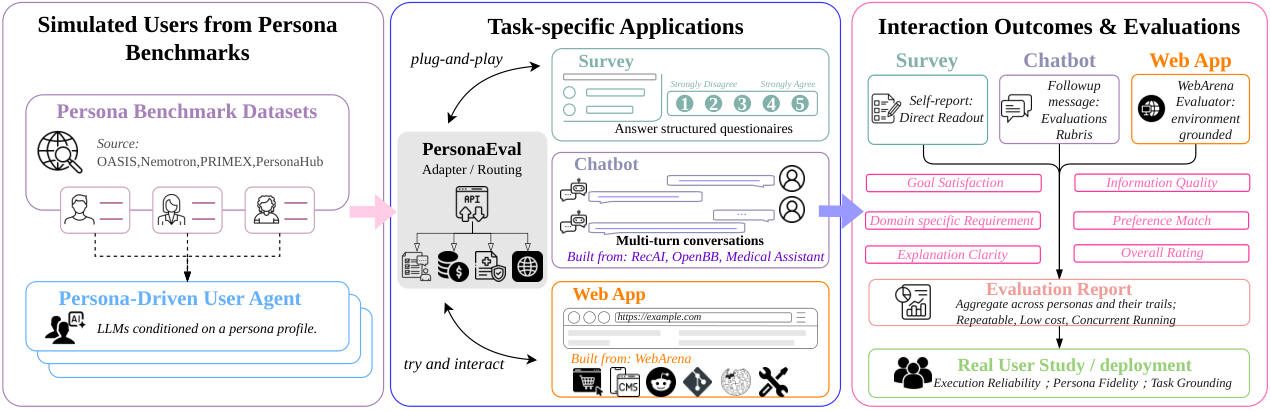
Everything follows from splitting the simulation into two APIs that know almost nothing about each other.
The Persona API wraps a language model as one simulated user. It receives an assigned persona and a task instruction, and it returns the next user behaviour through whatever interface the task requires. That behaviour is a survey response in one setting, a chat message in another, and a browser action in a third. Nothing about the persona side changes when the application changes.
The Task API packages an environment. It defines the task instruction, hosts or connects to the system under test, manages the interaction protocol, and supplies the evaluation form. A chatbot task connects the user to a chat endpoint. A web task hosts a site and exposes it through a browser.
Each run executes inside a sandbox with declared resources and controlled dependencies. That is more than hygiene. Different applications need different code, data, browser environments, and backend services, and without isolation the persona population cannot be shared across applications that disagree about their dependencies.
The design has one consequence that shapes how every number in the paper should be read. The same persona-conditioned model instance that produced the interaction also fills in the post-interaction evaluation form, in character. Satisfaction is therefore reported from the assigned user’s point of view rather than judged externally. The authors present this as a feature, and it is a coherent choice for a harness whose purpose is capturing subjective experience. It also means the evaluation and the behaviour share an author.
Method
The persona corpus and how applications get users
A persona here is a fixed, self-contained description of one user, drawn from an existing dataset rather than written per task. That is the reuse mechanism. The demo bundles 336 curated profiles from four sources: Nemotron-Personas-USA, PersonaHub, PRIMEX, and OASIS. The reported runs use the Nemotron subset.
Each profile is a structured record with demographics, several facet narratives covering areas such as professional life and social life, a free-text background, and explicit attribute lists. A loader renders all of that into one humanised text block that goes into the system prompt.
Matching applications to users is deliberately mechanical. The application’s short description is embedded, personas are ranked by similarity to it, and the nearest fifty are kept. This stands in for recruiting participants whose background fits the study, and it gives every application a fifty-user test set with no manual curation. The cost of the shortcut is that relevance is decided by text similarity between a product blurb and a profile, which is a weaker filter than a screening questionnaire.
The simulated user
The Persona API’s system prompt composes three things: the application context, a short description of the system under test, and the rendered persona block. A goal-context template then gives the user four standing instructions. Infer a realistic goal along with the constraints and preferences that matter to it. Reveal those needs gradually instead of dumping them in the first message. React to the application by confirming, pushing back, or asking for clarification. Keep messages to one to three sentences.
Those instructions are the paper’s model of what a real user does, and they encode a specific theory of user behaviour. Gradual disclosure in particular is the behaviour that makes multi-turn evaluation informative, since a user who states every constraint up front turns a conversation into a single query.
Decoding is strict JSON at every step, at temperature 0.7, with Claude Haiku 4.5 as the simulated user throughout.
The three adapters
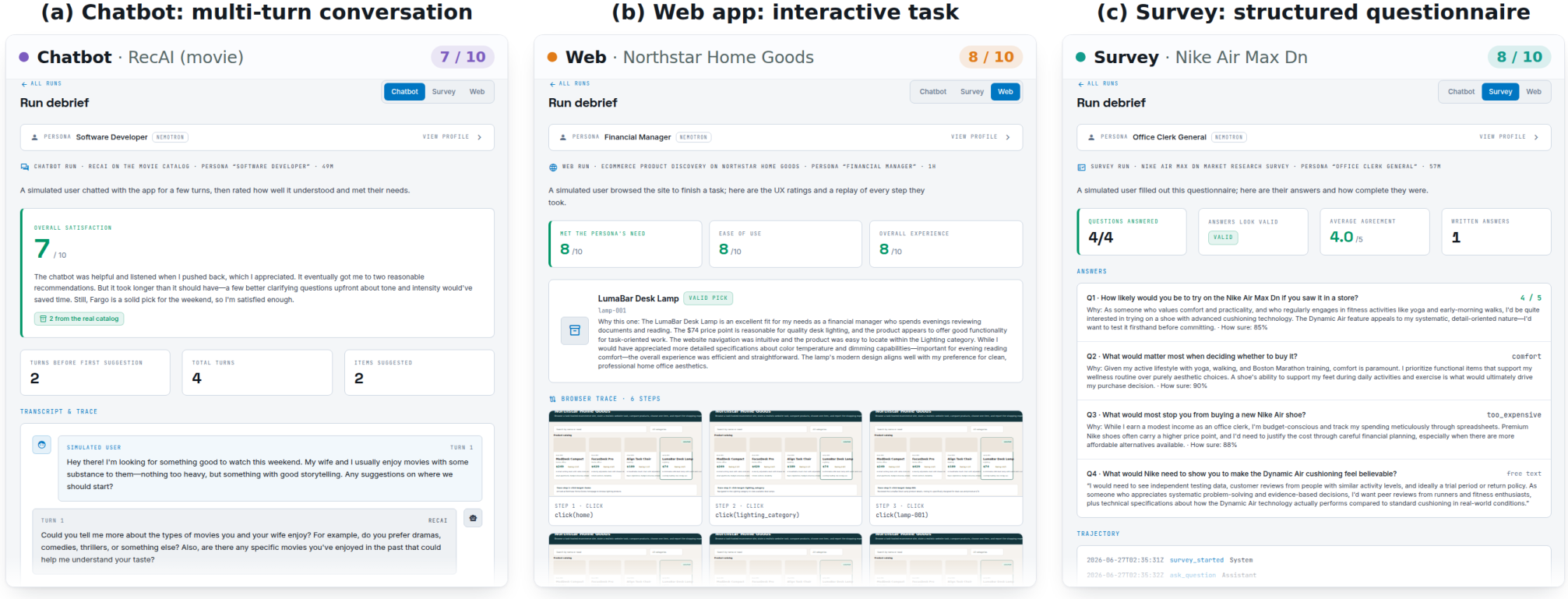
Survey is a single submission. The user reads a market-research instrument and returns one JSON object holding answers, rationales, confidence scores, and a trajectory. Evaluation is the completed survey plus validation checks on completeness and schema conformance.
Chatbot is a multi-turn conversation capped at eight turns. The user forms a goal from the persona, reveals needs gradually, answers follow-up questions, and stops once it can judge whether the system met the need. Four backends are wired in. Movie and beauty recommendation run on RecAI and InteRecAgent. Financial research runs on OpenBB. Medical consultation runs on a multi-agent medical assistant. All four applications run on GPT-4o mini.
Web is a browser session against a WebArena ecommerce site. The user states a concrete closed-loop task, navigates, compares options where possible, completes a sandbox checkout, and then evaluates the experience. The controller records browser actions and screenshots.
One implementation detail is worth noting because it affects the results. The finance and medical tasks share the generic chatbot evaluation form rather than carrying domain-specific scoring fields, so their satisfaction numbers are answering questions written for a recommender.
Experiments
Six application entries, fifty personas each, with the survey entry pooling three market-research instruments.
| Application | Overall | Clarify | Done | Cap hit | Persona alignment | Turns or steps | Grounded items |
|---|---|---|---|---|---|---|---|
| Survey (3 instruments) | 0.66 Likert | — | 1.00 | — | 0.95 | — | — |
| Chatbot — Movie | 0.60 | 0.30 | 0.74 | 0.26 | 1.00 | 6.6 turns | 15.2 |
| Chatbot — Beauty | 0.59 | 0.36 | 0.84 | 0.16 | 0.96 | 6.1 turns | 8.3 |
| Chatbot — Finance | 0.64 | 0.88 | 0.08 | 0.92 | 1.00 | 7.9 turns | 28.6 |
| Chatbot — Medical | 0.57 | 0.06 | 1.00 | 0.00 | 0.92 | 5.2 turns | 0.0 |
| Web — Ecommerce | 0.79 | — | 1.00 goal | — | 1.00 | 3.0 steps | — |
The satisfaction column is nearly flat. Every chatbot lands between 0.57 and 0.64, and the standard deviations of roughly 0.2 swallow the differences. Reading down that column alone, the four applications look like variations on the same middling experience.
The process columns tell a different story, and they are where the harness earns its keep. The financial chatbot asks a clarifying question on 88% of runs, hits the eight-turn cap on 92%, and reaches a completed outcome on 8%. Its turn count is 7.9 with a standard deviation of 0.3, which is the signature of a conversation that never converges and simply runs out of budget. The medical assistant is the mirror image. It clarifies on 6% of runs, finishes every one of them, and averages 5.2 turns. Its grounded-item count is exactly zero, meaning it never surfaced a retrievable item during the conversation. Two systems with satisfaction scores 0.07 apart are behaving in completely different ways, and only the trace metrics say so.
The web entry is worth flagging for the opposite reason. Its scores are unusually tight, and the step count is 3.0 with zero variance across fifty runs. A constrained checkout flow will genuinely compress outcomes, and a variance of exactly zero on a behavioural metric is also what a scripted path looks like. The paper does not distinguish the two readings.
Persona alignment. A one-to-five score, described in the paper as human-judged, rates whether each simulated interaction is consistent with the assigned persona, taking into account the goal, the trace, and the completed form. It stays high everywhere, between 0.92 and 1.00 after normalisation. Lower scores cluster in tasks that require sustaining professional knowledge or personal constraints over several turns. What the paper does not report is how many judges there were, whether they agreed, or how the rubric was written, so the number establishes that the simulation looks persona-consistent to whoever scored it rather than that alignment was measured to a standard.
Persona groups. Clustering the selected personas inside each application produces soft groups rather than clean classes. Mean pairwise cosine distance sits at 0.82 to 0.83, and silhouette scores run from 0.09 to 0.21 with heavily overlapping ellipses. The authors are careful about this and use the clusters descriptively only.
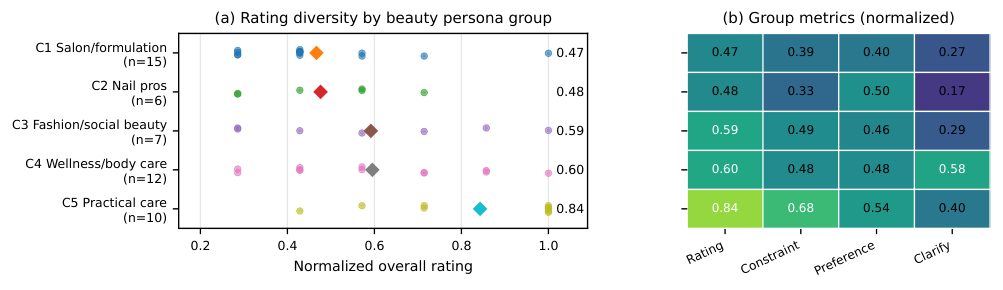
The beauty case is the clearest demonstration of what the harness is for. Reading the full profiles, the authors name five groups: salon and formulation users, nail professionals, fashion and social beauty users, wellness and body care users, and practical care users. The first two rate the recommender lowest, because their goals require professional sourcing, ingredient details, or salon inventory. Practical care users rate it highest, because the catalogue actually contains what they want. The aggregate score of 0.59 hides a catalogue-coverage problem that is specific to two user segments, and the group breakdown surfaces it. That is a plausible product finding, generated without recruiting anyone.
The spread across groups is itself informative. Beauty, medical, and movie show wide group-to-group variation. Survey, finance, and web show narrow variation. Applications whose value depends on matching a specific need are the ones where user segment matters most, which is the expected pattern and a reasonable sanity check on the harness.
Limitations
The central caveat is one the authors state plainly and then leave open. No comparison against real users appears anywhere in the paper. Every satisfaction number, every clarification judgment, and every reason string is produced by Claude Haiku 4.5 conditioned on a persona, and there is no evidence in this work about how any of it relates to what a human in the same situation would report. The authors list calibration against real-user behaviour first among the future-work items, which is the right priority.
The self-report loop compounds this. Because the same instance both acts and grades, a systematic tendency in the model appears twice and cannot be separated out. If the simulator is inclined to be agreeable, it will behave agreeably during the conversation and then rate the experience agreeably afterwards, and the two will corroborate each other.
Coverage is thin by construction. One simulator model, one application model, six application entries, fifty personas apiece. There is no ablation on the simulator model, so how much of the observed behaviour belongs to the harness and how much to Claude Haiku 4.5 is unknown. Two of the four chatbot tasks are scored with a form written for a different domain, which makes their satisfaction numbers hard to compare with the other two.
Persona selection by embedding similarity between a product description and a profile is a coarse proxy for recruiting. It will reliably find personas whose text overlaps with the application’s text, and it has no way to find the user who would be interested for a reason the description does not mention.
Finally, the diagnosis stops at the boundary. The harness surfaces that the financial chatbot never converges within eight turns. It does not say whether the cause is the chatbot’s behaviour, the eight-turn cap, or a simulated user that will not commit, and separating those would need either a cap sweep or a human comparison.
References
- Original paper: PersonaEval: Persona-Based User Simulation for Evaluating Interactive Applications
- Persona corpora: Zhang et al. (2018), PersonaChat; Ge et al. (2024), Persona-Hub; NVIDIA (2025), Nemotron-Personas; Wang et al. (2025), DeepPersona
- Simulation frameworks: Vezhnevets et al. (2023), Concordia; Yang et al. (2024), OASIS; Microsoft (2025), TinyTroupe; a16z Infra (2023), AI Town
- Persona-faithfulness benchmarks: Samuel et al. (2024), PersonaGym; Tu et al. (2024), CharacterEval; Hu et al. (2025), SimBench; Yao et al. (2024), τ-bench
- Applications under test: Huang et al. (2023), RecAI; Lian et al. (2024), InteRecAgent; Zhou et al. (2024), WebArena; OpenBB (2026)
- Survey replication fidelity: Cui et al. (2024), on LLMs recovering 73–81% of human experimental main effects with inflated effect sizes
- Related coverage in this series: Plausible but Not Valid (why simulated respondents need anchors); Concordia and OASIS (the simulation frameworks this harness sits beside)