Hierarchical Multi-Persona Induction — Truthful Profiles from Noisy Logs
A three-level hierarchy aggregates behavioral logs into intent memories and clusters them into evidence-grounded personas, trained with groupwise DPO to optimize for coherence, alignment, and truthfulness simultaneously.
Background
User modeling from behavioral logs underlies personalized recommendation, conversational assistants, and clinical decision support. The standard pipeline extracts a flat user profile: a paragraph or bullet list summarizing observed preferences (“interested in hiking”, “prefers Italian food”). Two systematic failure modes plague flat profiles.
Within-user diversity is lost. A real user’s behavior interleaves multiple distinct intents: health queries on Monday, travel research on Wednesday, book recommendations on Friday. Collapsing this into one profile either averages out the diversity or cherry-picks the most frequent pattern, losing the minority personas that may be most relevant for a given query.
Truthfulness is not enforced. LLMs trained to be helpful tend to over-generalize: a few queries about hiking become “the user is an outdoor enthusiast who prefers strenuous activity”. This over-generalization is a form of hallucination — the model generates a persona claim that goes beyond what the evidence supports. For safety-sensitive applications (clinical, financial) this is directly harmful; for recommendation it degrades precision.
Prior work has addressed these problems separately: multi-aspect profiling captures diversity, and constrained generation reduces hallucination. This paper addresses them jointly through a training objective that treats both as dimensions of a single quality score.
Core Idea
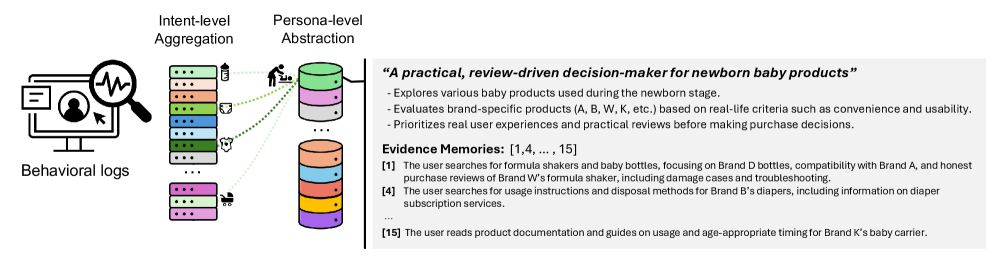
The hierarchy has three levels:
Level 1 — Intent memories. An LLM (Gemma3-12B) reads each day’s behavioral logs and produces a compact intent-level summary, filtering out noise and indexing the dominant intent behind the day’s actions. For a user who searched for “trail running shoes”, “blister prevention”, and “half marathon training plan” on the same day, the intent memory might read: “preparing for a first half-marathon, prioritizing injury prevention and footwear selection.”
Level 2 — Persona clusters. Intent memories are clustered (by embedding similarity) across the full log history, and each cluster is labeled by the LLM with a persona description. A user might end up with 3–5 personas: runner, home cook, weekend reader. Each persona carries an evidence set — the specific intent memories that support it.
Level 3 — Quality optimization. The persona descriptions are not accepted as-is. A scalar quality score evaluates each proposed persona set:
Three terms carry the score. is cluster cohesion, the embedding variance within the evidence set, penalized for incoherence. is persona-evidence alignment, an LLM judge rating how well the persona description matches its evidence set. is truthfulness, the same judge checking that no claim reaches past the evidence.
Method
Groupwise DPO training
Standard Direct Preference Optimization (DPO) trains on pairs (winner, loser). The quality decomposition above produces scalar scores for multiple candidate persona sets, which enables a richer training signal: groupwise DPO.
For each user in the training set, candidate persona sets are generated from the initial policy . Quality scores are computed and converted to soft preference weights . The groupwise DPO loss is:
where is the weighted reference (the “average loser”). KL divergence to regularizes the trained policy , preventing mode collapse toward a single style of persona description.
The practical effect is that the model learns to tell apart three qualitatively different ways to be wrong — incoherent clusters, misaligned descriptions, hallucinated claims — and to hold all three down at once.
Compression analysis
A key empirical question is whether the hierarchy loses critical information. The answer depends on dataset characteristics:
| Dataset | Raw logs/user/day | Intent memories/user | Personas/user |
|---|---|---|---|
| Srv (service) | 291 | 83.6 | 4.8 |
| MerRec (shopping) | 133.7 | 42.6 | 2.4 |
| AOL (web search) | 115.4 | 65.3 | 5.1 |
A 50–97% compression in token count, yet downstream Hit@100 matches or improves over using the full raw log as context — the hierarchy filters out noise more than it discards signal.
Datasets and training setup
Three datasets span different behavioral modalities:
- Srv: A large-scale proprietary service log (tens of millions of users, 19.9±12.2 interactions/user/day). Highly diverse intent profiles.
- MerRec: Shopping recommendation logs (5.56M users, 8.2±9.6 interactions/user/day). Amazon-scale purchase and browsing behavior.
- AOL: Web search query logs (1,000 users, 5.2±2.2 queries/user/day). Classic IR benchmark.
Training uses 500 users per dataset (200 validation, 300 test). The test-set alignment and truthfulness scores are computed with an external judge (GPT-5.1) to reduce self-evaluation bias.
Experiments

Persona quality. The composite score (0–1) on the test set:
| Dataset | Ours | GPT-5.1 | Claude-4.5 |
|---|---|---|---|
| Srv | 0.769 | 0.679 | 0.716 |
| MerRec | 0.788 | 0.696 | 0.701 |
| AOL | 0.817 | 0.718 | 0.718 |
The gains over GPT-5.1 and Claude-4.5 baselines are consistent across all three datasets and all three quality components. The largest gains are on alignment and truthfulness — the two components most prone to over-generalization in direct LLM prompting.
Downstream utility (Hit@100 on future interaction prediction). A retrieval-based interaction predictor is initialized with the induced personas and evaluated on held-out future actions:
| Dataset | Ours | GPT-5.1 | Claude-4.5 |
|---|---|---|---|
| Srv | 0.7370 | 0.6387 | 0.6266 |
| MerRec | 0.7692 | 0.6315 | 0.6307 |
| AOL | 0.6782 | 0.5900 | 0.5714 |
Better persona quality translates consistently to better downstream prediction (+10–16% over the strongest baseline), validating that the quality decomposition captures signal that is predictively relevant, not just stylistically better.
Generalization across backbone models. The trained policy was transferred to four backbone models (Qwen3-14B, Qwen3-30B, Gemma3-12B, Gemma3-27B). All four show consistent improvement in both quality score and Hit@100 relative to the respective baseline, indicating that the training signal captures task structure rather than model-specific patterns.
Limitations
Four limits the authors flag. First, LLM-judge reliability: the alignment and truthfulness components of are scored by GPT-5.1 at test time to reduce self-evaluation bias, but judge consistency is not fully characterized — small changes in the judge’s evaluation style could shift the rankings. Second, offline RL only: the groupwise DPO training generates candidates from once and trains offline. Online RL approaches (GRPO-style iterative refinement) that regenerate candidates from as it evolves are unexplored; they could close the remaining quality gap but require more compute. Third, temporal persona management: the current framework induces personas independently over fixed time windows. A practical deployment needs a way to update an existing persona bank as new behavior accumulates — merging, deprecating, and splitting personas over time. This is named as future work. Fourth, privacy: user profiling from behavioral logs raises genuine risk of “unintended use of inferred user characteristics”, particularly for sensitive behavioral domains (health queries, financial searches). The paper acknowledges this without proposing a technical mitigation.
References
- Original paper: Hierarchical Multi-Persona Induction from User Behavioral Logs
- Emory NLP group: Jinho D. Choi (PI), emory-nlp.github.io
- Direct Preference Optimization: Rafailov et al. (2023), arXiv:2305.18290
- Groupwise DPO extension: related to RLHF with ranked lists, e.g. Yuan et al. (2023)
- MerRec dataset: arXiv:2402.xxxxx
- Related persona work: Persona Hub (Chan et al. 2024), arXiv:2406.20094; Jang et al. (2023) RECAP
- MemPalace comparison note: verbatim episodic memory (MemPalace) and intent-compressed user profiling (this paper) address different retrieval tasks and complement each other